Twelve Years of Public Deficits: When Will France Commit to Structural Spending Cuts?
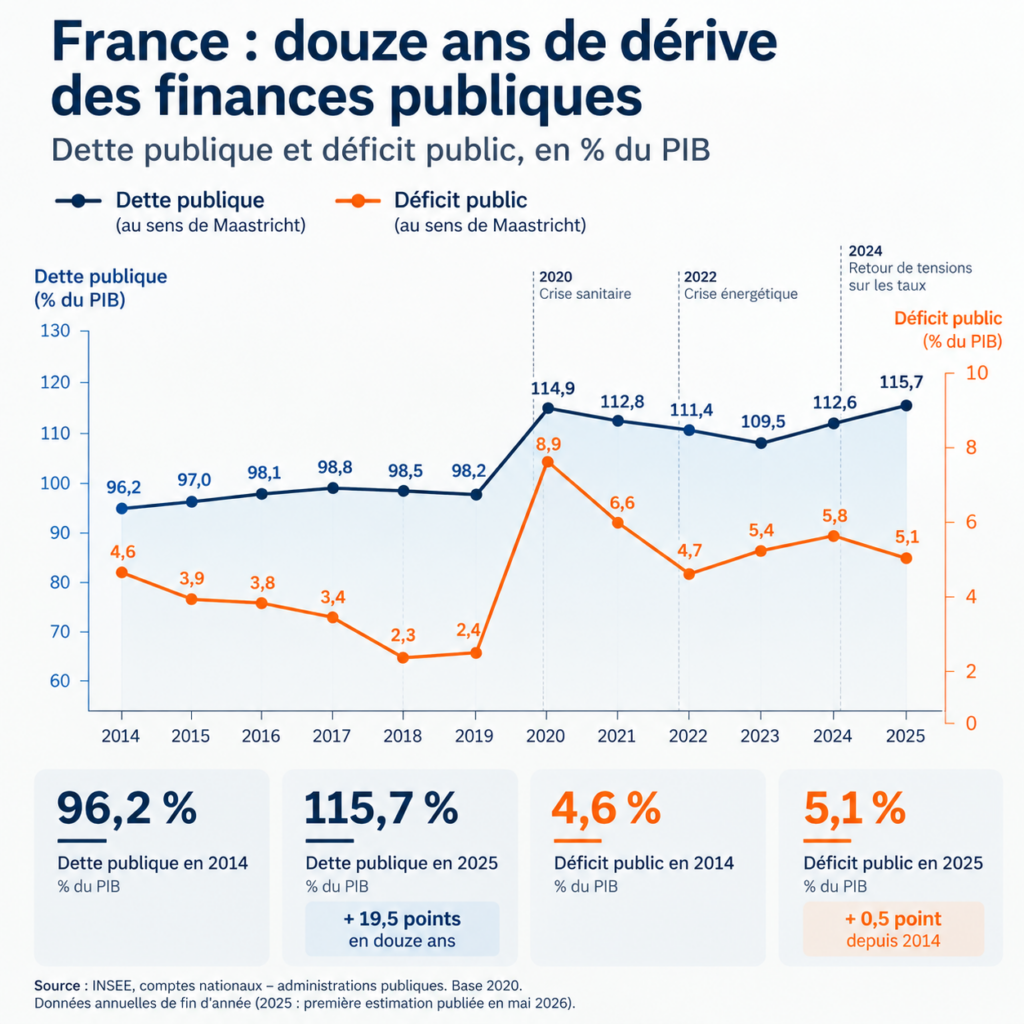
Over twelve years, France’s public debt has risen from 96.2% to 115.7% of GDP. Isn’t it time we finally addressed the need to reduce public spending?
In 2014, our deficit stood at 4.6% of GDP. It had fallen to 2.4% by 2019, before climbing back to 5.1% in 2025.
Successive crises explain part of this trajectory. But they cannot justify abandoning structural reform of public expenditure.
The challenge is not simply to control spending. It is to accept that spending must be cut where it fails to deliver sufficient value to society.
And certainly not by further weakening essential public services: healthcare, education, public safety, and defence. These missions need resources, but also efficiency.
Instead, let us examine how the state itself is organized.
In 2025, a French Senate inquiry identified 103 agencies, 434 operators, and 317 advisory bodies. Funding for operators amounted to approximately €80 billion in 2024.
Of course, not all these bodies are unnecessary. But how many responsibilities overlap? How many administrative costs could be avoided? How many organizations have undergone a genuine assessment of their usefulness?
Reforming the state is not just asking it to spend less. It means deciding what it should continue doing, do better, or stop doing.
The savings should also help us restore our capacity to invest in industry, expertise, sovereignty, and growth.
Public debt is not merely an accounting problem. It progressively limits our freedom to make decisions.
The question is therefore no longer simply how to finance our spending, but which expenditures we still want to finance, and why.
Sources: INSEE, general government accounts 2014–2025; French Senate, inquiry into state agencies, operators and advisory bodies, report no. 807, July 2025.